
If you have searched for Tristan name meaning in Hebrew, you are not alone. Many parents want to know whether this popular name carries a biblical or Hebrew background before choosing it.
The truth is simpler than most articles admit. Tristan comes from Celtic and Old French roots, not Hebrew, though its themes still connect to deep spiritual ideas. This guide breaks down the real history, the biblical status, and the symbolic meaning behind the name.
Is Tristan Mentioned in the Bible?
Does Tristan appear anywhere in Scripture? No, there is no character named Tristan in either the Old Testament or the New Testament.
The name simply did not exist during the biblical era, since it developed centuries later in medieval Europe. People searching for Tristan meaning in Hebrew often assume a hidden scriptural link, but no such reference exists in any translation.
The Hebrew Meaning and Origin of the Name Tristan
So where does the Hebrew meaning of Tristan actually come from? It does not, because the name has no linguistic root in the Hebrew language at all.
Tristan traces back to the Pictish name Drustan or Drust, meaning tumult or noise, later shaped by the Old French word triste, meaning sorrowful. When written in Hebrew script for transliteration purposes, it appears as טריסטן, but this is only a phonetic match, not a translation with inherent meaning.
Bible Verses That Reflect Tristan’s Meaning
While Tristan is not a biblical name, several verses reflect the emotional themes tied to its Old French meaning of sorrow.
- Psalm 30:5 speaks of joy coming after a night of weeping
- Isaiah 61:3 describes beauty replacing ashes and gladness replacing mourning
- John 16:20 promises that grief will eventually turn into joy
These verses do not define Tristan meaning in Hebrew directly, but they offer a spiritual lens for anyone drawn to the name’s emotional depth.
Biblical and Spiritual Significance of Tristan in Hebrew
Although Hebrew has no word for Tristan, certain Hebrew concepts mirror its themes closely.
| Hebrew Concept | Meaning | Connection to Tristan |
| Atsab | Sorrow or grief | Matches the Old French root triste |
| Chozek | Strength or resilience | Reflects growth through hardship |
| Simchah | Joy | Represents the hoped for outcome after sorrow |
This table shows how Tristan meaning in Hebrew is more of a thematic bridge than a direct translation.
Tristan Meaning in Hebrew
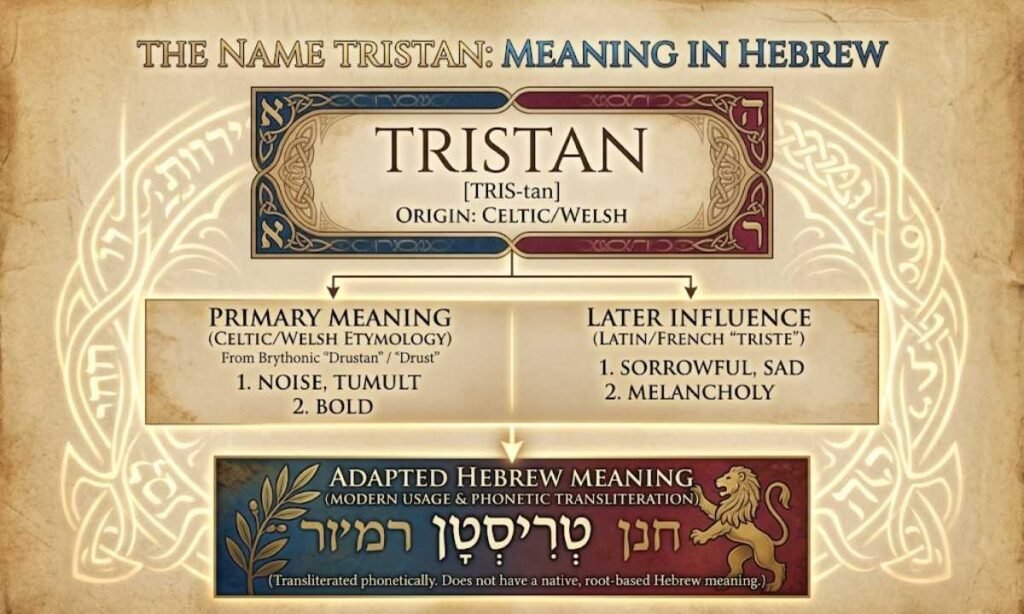
To put it plainly, Tristan has no formal Hebrew definition or biblical entry. What people usually mean when they search this phrase is whether the name carries any Hebrew-style symbolism, and the honest answer is that it does not, beyond the borrowed spiritual themes discussed above.
Tristan Name Meaning and Origin
Tristan’s full origin story spans three cultures rather than one. It began as a Pictish name in ancient Britain, was later adapted into Old French as triste, and became internationally known through medieval literature.
The name reached global popularity largely because of the tragic romance of Tristan and Isolde, which spread across Europe long before Hebrew naming traditions ever intersected with Western Europe.
Tristan Meaning in the Bible and Hebrew Tradition
Hebrew tradition typically builds names around divine references, using elements like El or Yah, or around specific virtues and life events. Tristan follows none of these patterns.
This is why Tristan meaning in the Bible and Hebrew tradition remains symbolic rather than literal. Christian families sometimes still choose it because its emotional depth pairs well with themes found throughout Scripture, even without a direct verse connection.
Spiritual Meaning of the Name Tristan
Beyond religious texts, many people interpret the spiritual meaning of the name Tristan through personality rather than etymology.
- A person who feels emotions deeply
- Someone who understands both hardship and compassion
- A quiet strength shaped by past struggles
- An old soul with emotional maturity 📖
These interpretations are cultural rather than linguistic, but they explain why the name still feels meaningful to many parents.
Is It a Good Christian Name?
Is Tristan a good name for a Christian household? Yes, plenty of common Christian names, such as Arthur or Brandon, also lack any biblical origin.
What ultimately matters is not whether a name appears in Scripture, but the values and character built around it. A name gains meaning through the life lived with it, not only through its dictionary definition.
Tristan in Legends vs Christian Truth
The most famous story behind the name is Tristan and Isolde, a medieval tale of forbidden love between Tristan and his uncle’s wife.
This legend directly conflicts with Christian teaching on marriage found in passages like Hebrews 13:4. However, many believers choose to separate the historical legend from the name itself, focusing instead on qualities like loyalty and devotion rather than the story’s moral failures.
Tristan Name Symbolism and Interpretation in Hebrew Culture
Hebrew culture places heavy importance on names reflecting destiny or divine promise, which is different from how Celtic names like Tristan were formed.
Still, Tristan name symbolism and interpretation in Hebrew culture can be understood through comparison. Where Hebrew names often declare an outcome, such as strength or peace, Tristan instead reflects an emotional starting point, sorrow, which many interpret as the beginning of growth rather than its end.
Tristan Name Origin
Historically, Tristan first appeared in Pictish Scotland before spreading through French Arthurian romance literature in the twelfth century.
From there, it moved into English, Spanish, and eventually global usage, gaining popularity again in the twentieth century as parents searched for names that felt both classic and unique.
Tristan Pronunciation
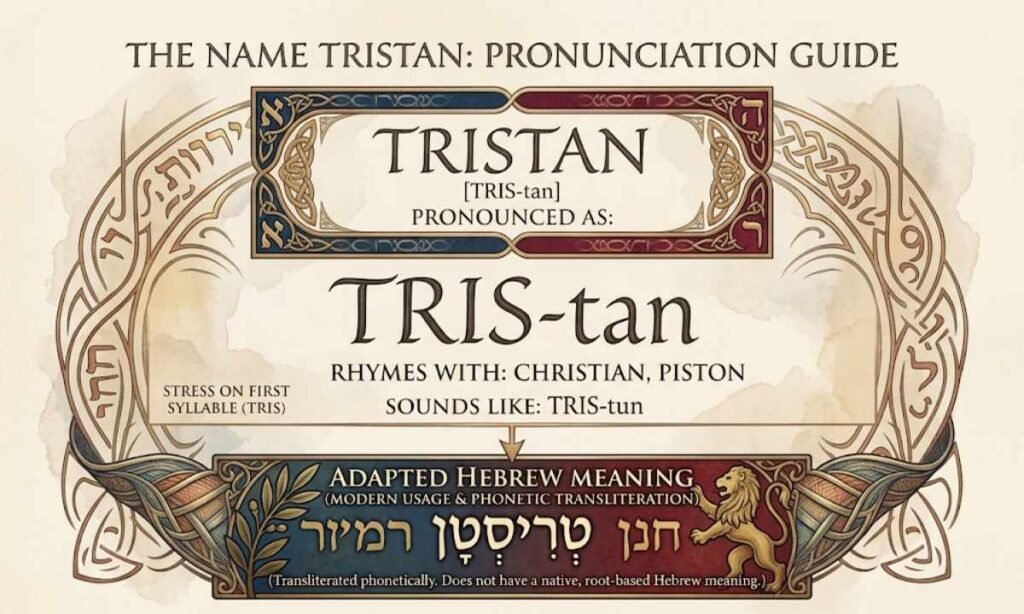
Tristan is most commonly pronounced as TRIS-tan in English speaking countries.
- English: TRIS-tan
- French: tree-STAHN
- Spanish: trees-TAHN
Each version keeps the same spelling but shifts emphasis based on regional accent patterns.
Popularity of the Name Tristan Today
Interest in the name has grown steadily among Gen Z parents who favor names with a literary or legendary background.
Its rise is largely tied to renewed interest in Arthurian legend retellings and fantasy media, rather than any religious or Hebrew connection. This trend explains why so many people now search specifically for Tristan meaning in Hebrew, expecting a hidden depth that etymology simply does not support.
Similar Hebrew Names With Deep Meaning
For parents who want a name with an actual Hebrew root and similar strength based symbolism, several alternatives exist.
- Oz, meaning strength
- Eitan, meaning firm or enduring
- Geber, meaning strong man
- Amatz, meaning to be strong or courageous
- Chaim, meaning life
These names offer the genuine Hebrew connection that Tristan itself does not carry.
Frequently Asked Questions
Does Tristan have a Hebrew meaning?
No, Tristan has no direct Hebrew meaning since it originates from Celtic and Old French roots.
Is Tristan found in the Bible?
No, there is no biblical figure or verse that mentions the name Tristan.
What does Tristan mean in English?
Tristan is generally translated as sorrowful or full of deep emotion.
Can Christians use the name Tristan?
Yes, many non-biblical names are commonly used within Christian families today.
Where did the name Tristan originate?
It originated from the Pictish name Drustan, later shaped by the Old French word triste.
Is Tristan a popular name in 2026?
Yes, it remains popular, especially among parents drawn to legendary or literary names.
What is a Hebrew alternative to Tristan?
Names like Oz, Eitan, or Chaim offer genuine Hebrew roots with similar strength themes.
Conclusion
Tristan does not carry a true Hebrew meaning, and it does not appear anywhere in the Bible. Its real story begins in Pictish Scotland, developed through Old French, and grew famous through medieval legend.
Even without a Hebrew or scriptural origin, the name still holds emotional depth through its meaning of sorrow transformed into strength. Many families continue choosing Tristan not for its etymology, but for the character and story they build around it.
Understanding this history helps set realistic expectations before naming a child. In the end, meaning is shaped as much by the life lived as by the roots of a word.